Construction
Engineered Wood Products
October 23, 2022
Engineered Wood Products
Engineered wood products (EWPs) represent the evolution of structural lumber: manufactured from wood veneers, strands, or fibers bonded with adhesives under heat and pressure to achieve performance characteristics that exceed what natural sawn lumber can reliably provide. EWPs are dimensionally stable, free from knots and natural defects, and optimized for structural efficiency.
They are the backbone of modern wood-framed construction, found in nearly every residential and light commercial project as the long-span and high-load complement to dimensional framing members.
Laminated Veneer Lumber (LVL)
LVL is produced by bonding thin wood veneers (typically 1/10" thick) with their grain parallel, creating a deep, stable beam or header. LVL beams are used where dimensional lumber would be oversized or require multiple plies: long-span floor beams, garage door headers, ridge beams, and transfer members. They’re typically 1¾" wide and available in depths from 5½" to 18" and beyond in laminated combinations.
Because LVL is manufactured without growth defects and with consistent grain alignment, it has predictable, high-quality design values: bending strength (Fb) typically 2,600 psi versus 900–1,200 psi for #2 dimensional lumber.
Wood I-Joists (TJI / BCI)
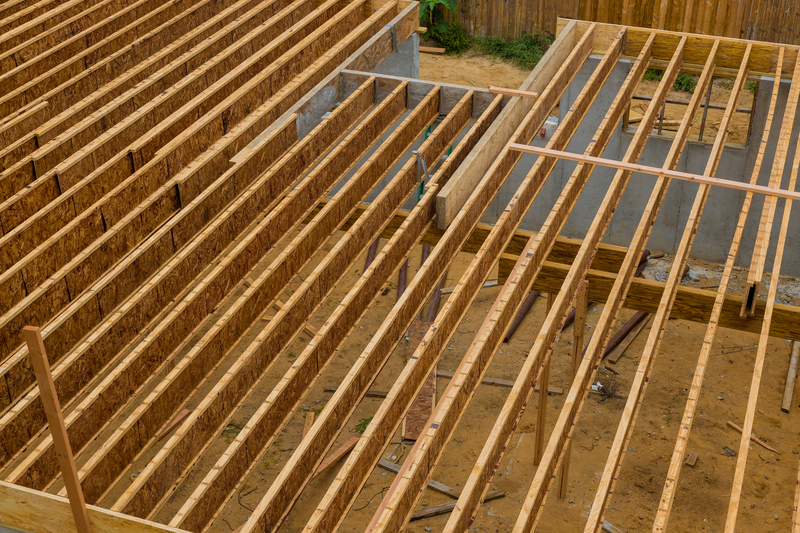
Wood I-Joists consist of a top and bottom flange of LVL or structural composite lumber (SCL) connected by a web of oriented strand board (OSB). The I-profile puts material where it’s needed: flanges carry bending stress, webs carry shear. This makes them far lighter and shallower than solid dimensional members for the same span.
I-joists are available in standard depths from 9½" to 24" and are used for floor systems and roof rafters in residential and light commercial construction. Engineered layout documents (EWP drawings) specify joist size, spacing, blocking, and web stiffener requirements for each project.
Web openings for mechanical and electrical runs can often be pre-punched or field-cut within manufacturer-specified limits, but this must be reviewed. I-joist webs are not interchangeable with solid sawn members when it comes to field modification.
Parallel Strand Lumber (PSL)
PSL is formed from long strands of veneer bonded parallel to the grain and pressed into billets that are then sawn to size. PSL has extremely high strength and stiffness and is used for columns, posts, and large beams where LVL or dimensional lumber is insufficient. It has a distinctive striated appearance that some designers leave exposed in architecturally finished spaces.
Laminated Strand Lumber (LSL) and Oriented Strand Lumber (OSL)
LSL and OSL use shorter, more abundant fiber sources (poplar, aspen) and are engineered for rim boards, studs, and shorter-span applications where cost matters more than maximum strength. LSL is dimensionally stable enough to use as a rim board: it won’t shrink, warp, or spring like green dimensional lumber.
Engineering Considerations
EWPs must be designed and specified using the manufacturer’s published design values and engineering tables: generic NDS values do not apply. Products from different manufacturers are not always interchangeable. Wet service and temperature adjustment factors apply where exposure conditions warrant. Connections require careful detailing: I-joist flanges are small and must not be notched; PSL and LVL can split along the glue lines if improperly fastened.
Always verify that EWP assemblies match the approved engineering documents. Field substitutions based on visual similarity have caused failures.
Ready to Talk Through Your Project?
Frontier Structural Engineering brings 20 years of commercial and residential design experience to projects across Colorado and California. Whether you're in schematic design or already in the field, we're available.
☎ Call 719 247-2928