Construction
Existing Materials
December 1, 2022
Existing Building Materials
The existing building stock presents a fundamentally different engineering challenge than new construction. Rather than designing from a blank page with known, standardized materials, the forensic and retrofit engineer works with what’s there: materials manufactured under different standards, with different geometries, and with decades of loading, modification, and weathering history. Understanding these legacy systems is essential for renovation, adaptive reuse, structural repair, and code compliance under the International Existing Building Code (IEBC).
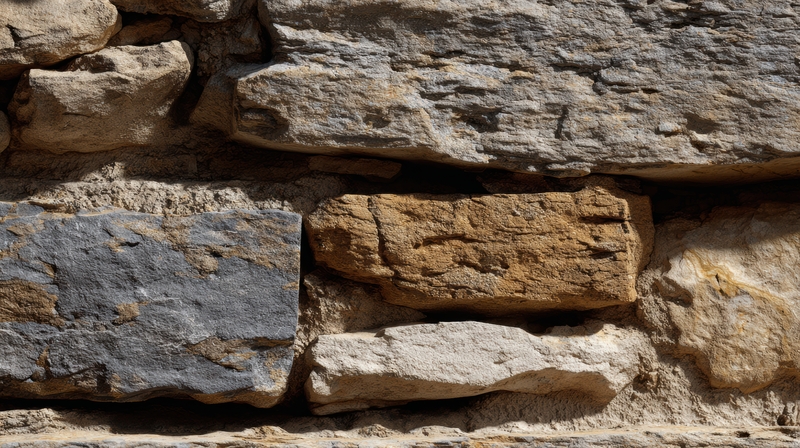
Mass Stone Masonry
Stone masonry construction predates modern structural engineering. Mass stone walls (rubble stone, coursed fieldstone, or cut ashlar) rely on sheer weight and mass to carry gravity loads and resist overturning. They have no reinforcing and no reliable tensile capacity. Mortar, where it exists, is often lime-based and has carbonated over the decades into a weak, permeable matrix.
Mass stone walls perform well in pure compression but are highly vulnerable to out-of-plane bending from seismic or wind forces. Lateral stiffness is unpredictable because the wall’s response depends on the quality of the mortar and the interlocking geometry of the individual stones, neither of which is uniform. Structural evaluation of existing stone masonry typically involves field investigation (probing mortar joints, measuring wall thickness, documenting openings and discontinuities) combined with a conservative assessment of capacity.
Repair of stone masonry most often involves repointing deteriorated joints with compatible mortar (not Portland cement, which is too rigid and can damage historic stone), reintegrating displaced stones, and adding supplemental connections to the diaphragm where the original construction lacked them.
Full-Size (True) Dimensional Lumber
Before the 1960s, dimensional lumber was sold at its full nominal size. A 2×4 was actually 2 inches by 4 inches, not the 1½"×3½" of modern dressed lumber. A 4×12 floor joist was truly 4 inches wide and 12 inches deep. This “full-size” or “true” lumber has a significantly larger section modulus and moment of inertia than modern equivalents.
When evaluating existing floors and roofs framed with full-size lumber, published NDS span tables for modern lumber are not applicable. Design values must be referenced from the historical edition of the NDS or the applicable grading rules in effect when the building was constructed. The section properties must be calculated from the actual (full) dimensions, not assumed from modern nominal sizes.
Full-size lumber also tends to be denser and slower-grown than modern plantation timber, often exhibiting tighter growth rings and higher actual design values for bending and shear than published historical grades would suggest, though this must be verified by a qualified lumber grader if it is to be relied upon.
1x Board Sheathing (Diagonal and Straight)
Before OSB and plywood, roofs and walls were sheathed with 1-inch nominal (¾" actual) boards. Diagonal board sheathing (boards applied at 45° to the framing) acts as a structural diaphragm by engaging the boards in axial tension or compression. Straight sheathing provides minimal diaphragm action. This distinction is critical when evaluating the lateral system of an existing building.
Diaphragm capacity of diagonal board sheathing is published in older references (e.g., SEAOC Blue Book, early editions of SDPWS) and can be used to establish the existing lateral capacity. Straight-sheathed roofs often have little to no engineered diaphragm capacity and may require supplemental plywood overlays or other means of lateral force distribution in a retrofit.
Board sheathing in older buildings is often split, checked, or notched from field modifications. Visual inspection is needed to assess the condition of the existing boards and the nailing, which is typically cut nails driven by hand.
IEBC and the Existing Building Code Framework
The International Existing Building Code (IEBC) governs structural work in existing buildings and provides three compliance paths:
Prescriptive Compliance: Specific rules for common alteration types. Straightforward additions and renovations in low-seismic, low-wind areas can often comply prescriptively.
Work Area Method: Triggered by the scope of work relative to the building’s total floor area. As the proportion of altered area increases, progressively more of the existing building must be brought into compliance with current code requirements.
Performance Compliance: The existing building (or the altered portion) is demonstrated through analysis to meet a specific performance objective that may differ from, but is deemed equivalent to, current code intent. This approach provides the most flexibility and is commonly used for historic structures or complex adaptive reuse projects.
The choice of compliance path affects which deficiencies must be corrected, how lateral loads are redistributed after modifications, and what triggers a full seismic upgrade. We guide clients through this process to identify the most cost-effective path that achieves structural safety without over-triggering upgrades beyond the project’s scope.
Ready to Talk Through Your Project?
Frontier Structural Engineering brings 20 years of commercial and residential design experience to projects across Colorado and California. Whether you're in schematic design or already in the field, we're available.
☎ Call 719 247-2928