Construction
Precast Concrete
November 1, 2022
Precast Concrete
Precast concrete is manufactured in a controlled plant environment, cured under ideal conditions, and transported to the site for erection by crane. The result is a product of higher dimensional accuracy and more consistent quality than field-cast concrete. Because manufacturing and site work happen in parallel, precast construction can significantly compress the project schedule.
Precast is a primary structural system for parking structures, industrial and warehouse buildings, stadiums, and multi-story residential. It is also widely used as an architectural cladding and facade system independent of the primary structure.
Structural Precast Members
Double Tees (DTs) are the workhorse of precast floor and roof construction. Their distinctive twin-stemmed profile spans 40 to 80 feet or more and supports tributary areas efficiently. DTs are common in parking garages, where their span and exposed durability are exactly what the application demands. Prestressed strands run through the stems, allowing slender flanges to carry significant bending moment.
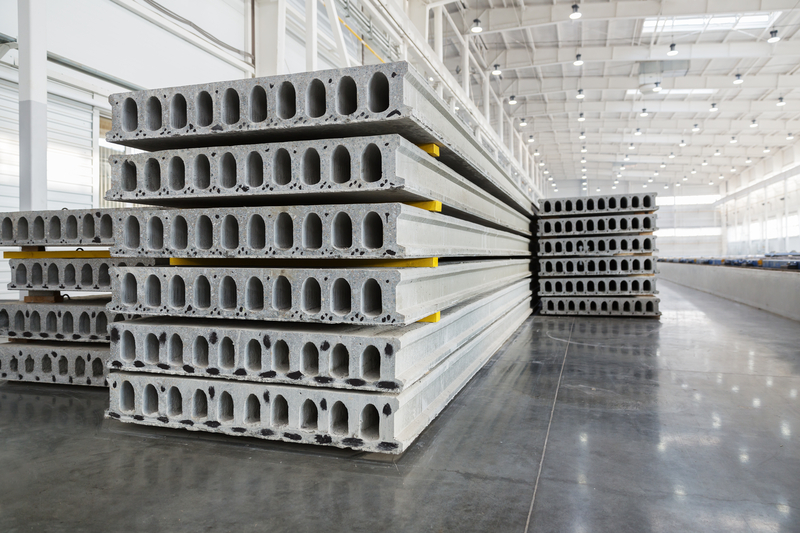
Hollow-Core Planks are prestressed slabs with longitudinal voids that reduce weight without reducing structural depth. They span 20 to 50 feet and are used for floors in multi-family residential and office buildings. Hollow-core is laid side by side, with grouted keys between planks and a cast-in-place topping slab to create a diaphragm.
Inverted Tees and L-Beams support DTs and hollow-core planks at their ends. Ledges cast into the beam provide a bearing seat for the spanning members. These connections (resting on bearing pads and tied together with field-welded plates or grouted connections) must be carefully detailed for seismic and wind load transfer.
Columns and Walls are also precast, particularly in systems where a fully precast building frame is desired. Precast columns with corbels support the beam-to-column connection. Precast shear walls are erected and tied together with cast-in-place concrete at their connections.
Architectural Precast and Tilt-Up
Architectural precast panels (with textured, exposed aggregate, or smooth painted finishes) clad the exterior of buildings as non-structural cladding. GFRC (glass fiber reinforced concrete) panels are an ultra-thin, lightweight variant used for complex facade shapes.
Engineering Considerations
Precast design requires close coordination with the fabricator from early design through erection. Shop drawings, connection details, and handling sequences must all be reviewed and approved before production begins. Connections between precast elements are the most critical design consideration: they must transfer loads reliably while tolerating the dimensional tolerances inherent in both manufacture and field erection.
Seismic design of precast structures requires special attention to the ductility of connections and the integrity of the load path between elements. IBC and ACI 318 provide specific requirements for precast systems in moderate and high seismic zones.
Ready to Talk Through Your Project?
Frontier Structural Engineering brings 20 years of commercial and residential design experience to projects across Colorado and California. Whether you're in schematic design or already in the field, we're available.
☎ Call 719 247-2928